
When a Client Wants to Stop Therapy: Scripts for Premature Termination
By Kristen McClure, MSW, LCSW | TherapistWorksheet.com
A client tells you they’re done. Or they cancel twice in a row and stop responding to your scheduling messages. Or they say “I think I’m good” in a tone that doesn’t match the work you know is unfinished.
This is one of the most loaded moments in therapy — because leaving can mean so many different things. The client may genuinely be ready. They may be running from something that got too close. They may have lost faith in the process. They may not be able to afford it anymore. Or leaving may be the exact pattern that brought them to therapy in the first place.
The challenge is that you can’t always tell. And your reaction to being left matters more than you might think.
The Two Traps
Most therapists fall into one of two responses:
Holding on. This sounds like: “I really think you should stay. We have more work to do. Are you sure?” It comes from a good place. But it can feel desperate, and it removes the client’s autonomy.
Letting go too easily. This sounds like: “Of course. It’s your decision.” It comes from respect for autonomy. But it can feel dismissive — like you don’t care enough to explore what’s happening.
Neither of these serves the client. What serves the client is curiosity. An honest, collaborative exploration of what’s driving the desire to leave — without pressure, without performance, and without your own attachment anxiety running the show.
Scripts for the Conversation
When a Client Says “I Think I’m Done”
“I appreciate you telling me that directly. I want to take that seriously. Can we spend a few minutes exploring what’s behind that? Not to change your mind — but because I think understanding what’s driving this could be useful, even if you do decide to stop.”
This honors the client’s statement while keeping the door open for exploration.
When a Client Is Fading Out
“I’ve noticed that scheduling has been difficult lately, and I want to check in about that honestly. Sometimes it’s just life getting busy, and sometimes it’s something else. I’d rather we talk about it than have the therapy end without either of us naming what happened.”
When the Quitting Is the Pattern
This is the most delicate moment. You need to name what you see without it sounding like manipulation:
“I want to say something, and I want to be careful about how I say it because I don’t want it to land as pressure. You’ve told me that leaving when things get hard is something you’ve done in other relationships. I’m wondering if what’s happening right now is connected to that pattern. I could be wrong. But I think it’s worth looking at before you decide.”
This only works if the pattern has already been established in therapy. If you’re naming it for the first time in this moment, it will feel coercive.
When It’s Genuinely Time to End
Not every departure is premature. Sometimes clients are truly done. The signs:
- They can clearly describe what they gained
- They feel stable and resourced
- They’ve been thinking about it for a while, not impulsively
- Their life circumstances make continuing impractical
- The therapeutic relationship has run its natural course
When it’s real: “It sounds like you’ve gotten what you needed from this, and I think that’s worth celebrating. Not everyone knows when they’re done.”
The Door-Is-Open Script
Whether the client is ready or not, close with this:
“I want you to know that if you ever want to come back — in a month, a year, five years — the door is open. You don’t need a reason. You don’t need to be in crisis. You can just decide you want to talk.”
Mean it. Don’t say it as a line.
The Complete Toolkit
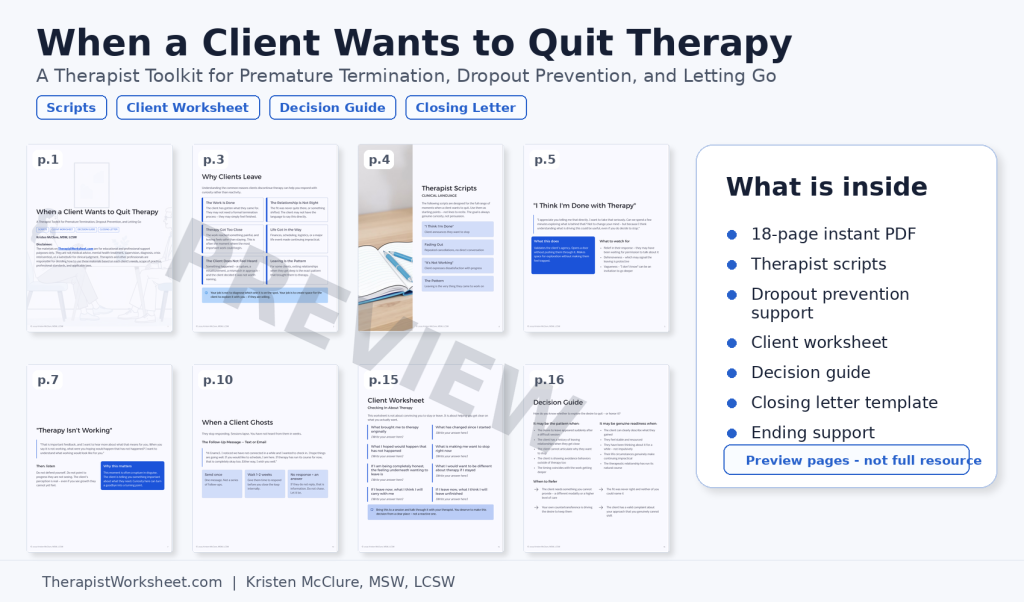
This post covers the core scripts. The full When a Client Wants to Quit Therapy Toolkit includes:
See the When a Client Wants to Stop Therapy Toolkit →
- 10 therapist scripts — client says “I’m done,” client ghosts, client says “it’s not working,” quitting after a rupture, “I can’t afford it,” and more
- A client reflection worksheet (“Checking In About Therapy”)
- A decision guide for when to explore vs. when to honor the departure
- A closing letter template
Frequently Asked Questions
How do I know if the client is leaving because of me?
Ask. Not defensively, but genuinely. “Is there anything about how we’ve been working together that hasn’t felt right?” If you can’t ask that without your anxiety spiking, take it to consultation.
Should I follow up if a client ghosts?
One message after 1–2 weeks is appropriate. Something brief: “I hope things are going well. If you’d like to schedule, I’m here. If therapy has run its course, that’s completely okay too.” After that, let it go.
What if a client keeps quitting and coming back?
This pattern is clinical material. Name it. “I notice that we have a pattern of starting, stopping, and restarting. I’m curious what that might be telling us.”
How do I manage my own feelings when a client leaves?
Take it to your own therapy or consultation. Clients leaving activates our own attachment patterns — and if we’re not aware of that, we’ll act it out in the room.
Kristen McClure, MSW, LCSW is a licensed therapist who creates practical clinical tools to help therapists navigate the hardest moments in their work.
[Browse the full library at TherapistWorksheet.com →]