When Clients Ask Personal Questions: A Therapist’s Guide to Self-Disclosure
By Kristen McClure, MSW, LCSW | TherapistWorksheet.com

“Do you have kids?” “Have you ever been through something like this?” “Are you married?” “Do you see a therapist yourself?”
Personal questions from clients are one of the most clinically loaded moments in therapy — and one of the least explicitly taught. Most therapists develop a default response over time: deflect everything, answer everything, or some inconsistent mix. None of those is a clinical approach.
This post gives you a framework for thinking through self-disclosure — when it serves the client, when it doesn’t, and what to actually say in the moment.
Why Clients Ask Personal Questions
Personal questions usually come from one of a few places:
- Genuine connection-seeking — wanting to feel less alone with you, to know you’re a real person
- Reality-testing — checking whether you can possibly understand their experience
- Avoidance — shifting focus away from something uncomfortable that was just emerging
- Testing the relationship — seeing how you handle vulnerability, whether you’re rigid or human
- Relational pattern — a habit of taking care of others, deflecting from themselves
The clinical response depends on understanding which of these is operating — and that usually means exploring the question before answering it.
The Three Decisions in Self-Disclosure
1. Do I answer at all? Not every question needs a direct answer. Exploring the question is always an option and is often more clinically useful.
2. If I answer, how much do I share? There’s a spectrum from “I’m not going to share that” to minimal acknowledgment to fuller disclosure. The amount should be calibrated to clinical purpose, not personal comfort.
3. What do I do after I answer? The most important part. Any self-disclosure should return focus to the client.
When Self-Disclosure Serves the Client
Self-disclosure is clinically indicated when it normalizes an experience, models vulnerability, repairs a rupture, reduces shame, or demonstrates that you can survive what they’re afraid of.
The test: Does sharing this serve the client’s therapeutic goals, or does it serve my need to seem relatable, avoid their discomfort, or manage my own anxiety?
Scripts for Common Personal Questions
“Do you have kids?”
“I’m curious what’s coming up for you as you ask that. What would it mean if I did — or didn’t?”
Or with minimal answer: “I do, yes. What’s making that relevant for you right now?”
“Have you ever experienced something like this?”
“I hear something important in that question — I wonder if you’re asking whether I can really understand, or whether you’d feel less alone if I had. What would it mean to you if I had or hadn’t?”
“Do you see a therapist yourself?”
“I have, yes. I think it’s important work for anyone in this field. What’s bringing that up for you today?”
“Are you married / in a relationship?”
“I’m curious what’s behind that question — sometimes when clients ask about my relationship status it’s connected to something they’re working through themselves. What’s coming up?”
When a client pushes after you’ve redirected:
“I notice we keep coming back to questions about me, and I want to take that seriously. What would feel different in here if you knew more about my life?”
What Not to Do
- Don’t answer reflexively out of discomfort with the pause — the pause is clinical space
- Don’t over-explain your policy on self-disclosure — a lecture about boundaries is its own deflection
- Don’t always redirect without acknowledgment — it can feel evasive and cold
- Don’t be inconsistent without knowing why — if you answer some questions and not others, that inconsistency is clinically meaningful
The Full Toolkit
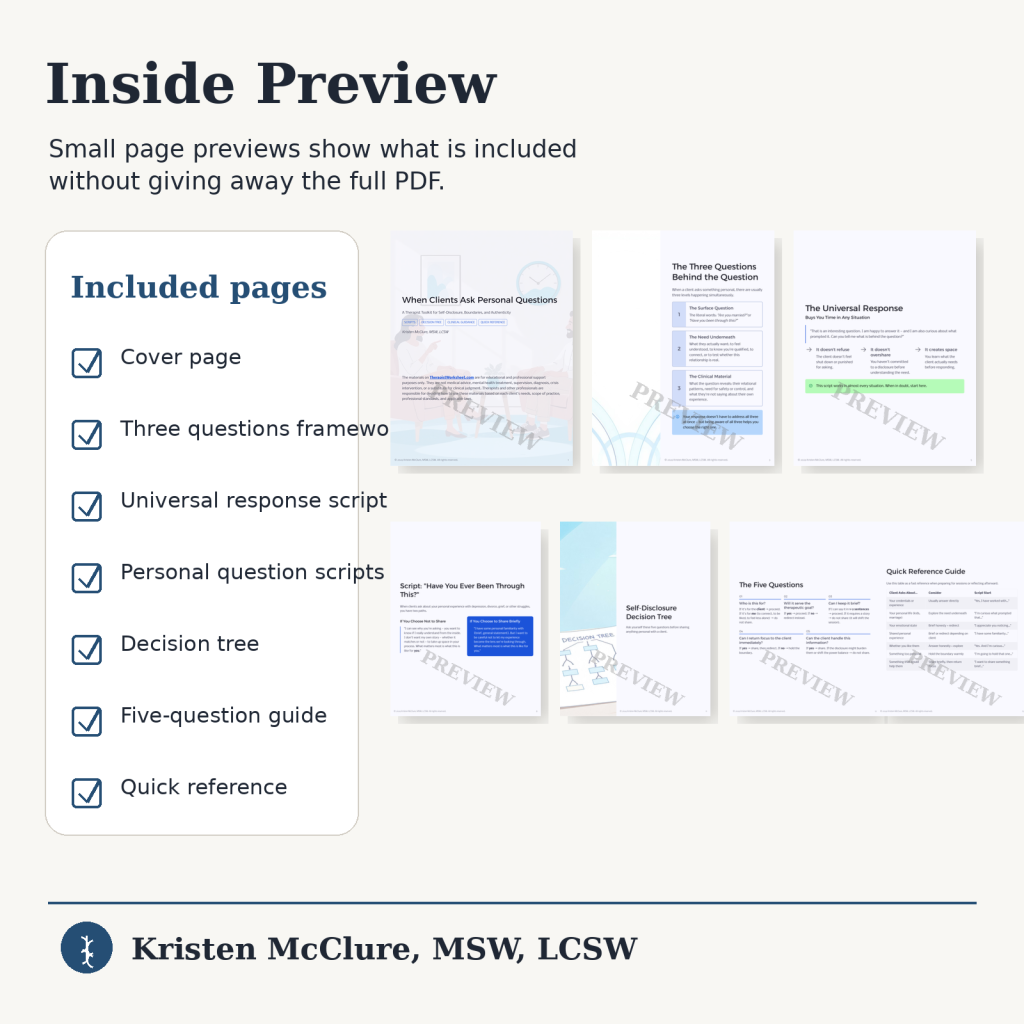
The When Clients Ask Personal Questions Toolkit gives you complete scripts for every type of personal question — with clinical guidance on when to answer, when to explore, and how to handle clients who push back on redirection.
See the Therapist Self-Disclosure Scripts & Clinical Guide →
Frequently Asked Questions
Is it ever wrong to answer a personal question?
Not wrong exactly — but disclosure that isn’t in service of the client’s treatment is worth examining. The question isn’t “am I allowed to answer?” but “does answering this serve them?”
What if I give a vague non-answer and the client finds out the truth?
Inconsistency or perceived deception damages trust far more than a thoughtful disclosure would have. If you’re not going to share something, say so directly rather than being evasive.
What about questions I find genuinely uncomfortable — religion or politics?
“That’s something I generally keep separate from my work — not because the question isn’t valid, but because I find it serves us both better. I’m curious what’s behind the question for you.”
What if the client says “I just want to know, it’s not that deep”?
“Fair enough — sometimes a question is just a question. And I also think the questions clients ask are rarely random. But I’m curious if there’s anything to it.”
Kristen McClure, MSW, LCSW is a licensed therapist who creates practical clinical tools to help therapists navigate the hardest moments in their work.
See the Therapist Self-Disclosure Scripts & Clinical Guide →